 Epic7DB
LPC1768FBD100K Alternatives: Cortex-M3 Microcontrollers with Ethernet and USB
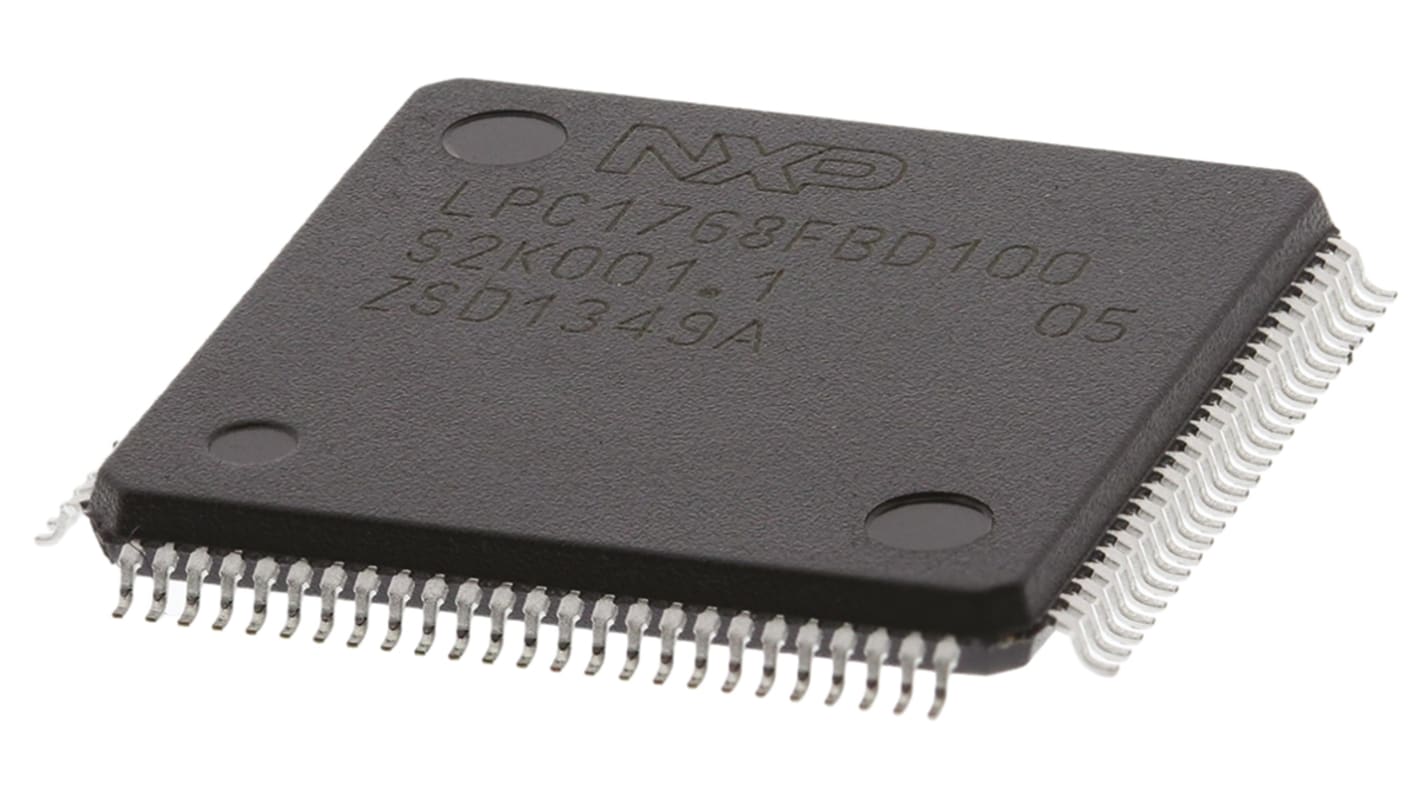
The LPC1768 has had an unusually long and busy life. It was one of the first Arm Cortex-M3 microcontrollers to put Ethernet, USB and CAN on one chip at a sensible price, and it became the heart of the original mbed development board. Later it found a second career in 3D printer controller boards. The result is a huge installed base of designs, firmware and engineers who know the part well.
That history is also why people go looking for alternatives. Some need a second source after a supply shortage. Some have outgrown its 100 MHz core or its 64 KB of RAM. Others are starting a new design and want to know whether a more recent part makes more sense. This article describes what the LPC1768FBD100K offers, lists the microcontrollers most often considered in its place, and explains what a move to each one involves.
What the LPC1768FBD100K offers
The LPC1768FBD100K is a 32-bit microcontroller from NXP based on the Arm Cortex-M3 core. Its main features are:
- Cortex-M3 core running at up to 100 MHz
- 512 KB of flash memory and 64 KB of SRAM
- 10/100 Ethernet MAC with RMII interface
- USB 2.0 full-speed interface with device, host and OTG capability
- Two CAN controllers
- Four UARTs, three I2C interfaces, SPI and two SSP ports
- 8-channel 12-bit ADC and a 10-bit DAC
- Motor-control PWM, a quadrature encoder interface and general-purpose timers
- Real-time clock with battery backup
- Up to 70 general-purpose I/O pins
- Single 3.3 V supply
In the part number, FBD100 identifies the package: a 100-pin low-profile quad flat pack with 0.5 mm lead pitch. The same silicon is also sold in a 100-ball BGA under a different package code. The trailing letter is an ordering suffix and does not change the electrical specification.
The combination is still a useful one. A single chip can run a TCP/IP stack, a USB interface, a CAN network and several serial devices at once, in a package that can be hand-soldered and inspected by eye.
Where it is used
- Industrial networking: protocol gateways between Ethernet, CAN and serial fieldbuses
- 3D printers and CNC machines: 32-bit controller boards with stepper control, USB and SD card support
- Metering and data logging: networked energy meters and remote monitoring units
- Building automation: access control panels, HVAC controllers and lighting gateways
- Education and prototyping: the mbed LPC1768 board remains a common teaching platform
Is the original still the right choice?
For an existing product, the answer is usually yes. Requalifying a microcontroller means porting drivers, re-testing every interface and often repeating compliance testing. If the only problem is finding stock, solve that problem first. Verified Electronics, a distributor of NXP components, lists the LPC1768FBD100K and uses third-party testing, which matters when you are buying a mature part on the open market.
For a new design, or where the product needs more performance or memory, the alternatives below are worth a serious look.
What to compare
When you assess a replacement, check these points in order.
- Connectivity. Does it have an Ethernet MAC, and does it need an external PHY? Is USB full-speed or high-speed, and does it support host mode? How many CAN channels?
- Core and speed. A Cortex-M3 at 100 MHz is the baseline. Cortex-M4 and M7 cores add DSP instructions and a floating-point unit.
- Memory. 512 KB of flash and 64 KB of RAM is the baseline. Network stacks with TLS need considerably more RAM.
- Package and pinout. Only parts from the same family are pin-compatible. Anything else means a new board.
- Software effort. Peripheral registers differ between vendors, so drivers must be rewritten or replaced with the vendor's library. Application code written against an abstraction layer or RTOS ports more easily.
- Tools and ecosystem. Compiler support, debug probes, middleware and community knowledge all affect schedule.
- Longevity. Check the manufacturer's stated availability commitment.
Alternative 1: NXP LPC1769
The LPC1769 is the closest possible alternative. It is the same design with a higher maximum clock speed of 120 MHz. Flash, RAM, peripherals, package and pinout match. Firmware built for the LPC1768 runs without change, and you can raise the clock afterward if you want the extra speed.
Best for: a drop-in second source, or a small performance increase with no board change. Several 3D printer boards have been sold in versions with each chip for exactly this reason.
Alternative 2: Other LPC176x and LPC175x parts
The rest of the LPC1700 series shares the same core and peripherals with different memory sizes and feature sets. Parts in the same 100-pin package are pin-compatible. Smaller members have less flash or omit Ethernet or one of the CAN channels, and the LPC175x parts come in an 80-pin package.
Best for: reducing cost where the design does not use all the memory, while keeping the same firmware base.
Alternative 3: NXP LPC4078 and LPC4088
These are the upgrade path within NXP's own range. They use a Cortex-M4 core with a floating-point unit at up to 120 MHz and keep a peripheral set close to the LPC1700 series: Ethernet, USB, CAN and the familiar serial interfaces. Much of the driver code carries over with modest changes. The LPC4078 is available in a 100-pin package, and the LPC4088 in larger packages with an LCD controller and external memory interface.
Best for: more processing power and floating-point math with the least software disruption.
Alternative 4: STMicroelectronics STM32F107
The STM32F107, part of ST's connectivity line, is the nearest match from another vendor in the same generation. It has a Cortex-M3 core at 72 MHz, up to 256 KB of flash, an Ethernet MAC, USB OTG full-speed and two CAN interfaces, in 64-pin and 100-pin packages.
Trade-offs: it is slower and has half the flash of the LPC1768. Its advantage is the STM32 ecosystem, with widely used configuration tools, libraries and low-cost debug probes.
Best for: teams already working with STM32 parts who need a like-for-like Cortex-M3 with Ethernet.
Alternative 5: STMicroelectronics STM32F207 and STM32F407
These two families are the more common choice for new Ethernet designs on STM32. The STM32F207 has a Cortex-M3 core at 120 MHz. The STM32F407 has a Cortex-M4 with floating point at 168 MHz. Both offer up to 1 MB of flash, considerably more RAM than the LPC1768, an Ethernet MAC, USB OTG in full-speed and high-speed variants, two CAN interfaces and a camera interface. Both come in 100-pin packages, and the two families are designed to be pin-compatible with each other.
Trade-offs: a full port of the low-level drivers is required, as with any change of vendor.
Best for: new designs that need more memory and speed, and a very large base of example code.
Alternative 6: Texas Instruments TM4C1294
The TM4C1294 family uses a Cortex-M4F core at 120 MHz with 1 MB of flash and 256 KB of RAM. Its distinguishing feature is an Ethernet MAC with an integrated PHY, which removes one chip and its crystal from the board. It also has USB with host and device support, two CAN controllers and a generous set of serial ports and timers.
Trade-offs: it comes in larger packages, 128-pin and above, so it needs more board space than a 100-pin part.
Best for: Ethernet products where a lower component count matters.
Alternative 7: Microchip SAM3X and SAM E70
The SAM3X8E is a Cortex-M3 at 84 MHz with 512 KB of flash, an Ethernet MAC, high-speed USB and two CAN controllers. It is known as the processor on the Arduino Due, which gives it broad hobbyist and prototyping support. The SAM E70 moves to a Cortex-M7 at 300 MHz with up to 2 MB of flash, Ethernet, high-speed USB and CAN FD, and is aimed at demanding industrial applications.
Best for: the SAM3X where Arduino-compatible tooling is helpful, and the SAM E70 where performance is the main need.
Alternative 8: NXP Kinetis K64
The Kinetis K64 is a Cortex-M4F at 120 MHz with up to 1 MB of flash and 256 KB of RAM, an Ethernet MAC with precision time protocol support, full-speed USB and CAN. Its low-cost development board made it a popular platform for networked embedded projects, and it is supported by NXP's current software development kit.
Best for: staying with NXP tools while moving to a newer, larger-memory part.
Comparison table
| Part | Core | Max speed | Flash (max) | Ethernet | USB | CAN | Pin-compatible |
|---|---|---|---|---|---|---|---|
| LPC1768 | Cortex-M3 | 100 MHz | 512 KB | MAC | Full-speed device, host, OTG | 2 | Baseline |
| LPC1769 | Cortex-M3 | 120 MHz | 512 KB | MAC | Full-speed device, host, OTG | 2 | Yes |
| LPC4078 | Cortex-M4F | 120 MHz | 512 KB | MAC | Full-speed | 2 | Check datasheet |
| STM32F107 | Cortex-M3 | 72 MHz | 256 KB | MAC | Full-speed OTG | 2 | No |
| STM32F407 | Cortex-M4F | 168 MHz | 1 MB | MAC | Full-speed and high-speed OTG | 2 | No |
| TM4C1294 | Cortex-M4F | 120 MHz | 1 MB | MAC and PHY | Host, device, OTG | 2 | No |
| SAM3X8E | Cortex-M3 | 84 MHz | 512 KB | MAC | High-speed | 2 | No |
| Kinetis K64 | Cortex-M4F | 120 MHz | 1 MB | MAC | Full-speed | 1 | No |
Confirm every figure against the current datasheet for the exact part number you are considering, since memory size and features vary within each family.
How much work is a migration?
Within the LPC1700 series: hours. Change the device setting, rebuild and re-test.
To the LPC407x or LPC408x: days to weeks. Startup code and clock setup change, most peripheral drivers need light edits, and the board may need changes depending on package.
To another vendor: weeks to months. Every low-level driver is replaced. The TCP/IP stack, USB stack and file system usually port cleanly if they sit above a hardware abstraction layer. Time-critical code such as stepper pulse generation needs careful re-validation, because timer behavior and interrupt latency differ. The board needs a full redesign around the new pinout.
A sensible approach is to isolate hardware access behind a thin layer before you start, port and test one peripheral at a time on the vendor's development board, and only then commit to a new board layout.
Differences that catch people out
A feature table hides several details that only show up during a port. Check these before you commit.
- Boot and programming. The LPC1768 has a serial bootloader in ROM, entered through a dedicated pin, and many production lines rely on it. Other families have different bootloaders with different interfaces and entry conditions.
- I/O voltage tolerance. Most LPC1768 digital pins tolerate 5 V inputs. Not every pin on every alternative does, which matters on boards that talk to 5 V logic.
- ADC behavior. Resolution may match while input range, sampling time and reference options differ.
- Clock sources. Ethernet and USB each need accurate clocks. The crystal frequency and PLL settings that worked before may not suit the new part.
- Power modes. Sleep and wake-up behavior differs widely, so battery-backed designs need fresh measurements.
Choosing by situation
- You need the same part and cannot find it: source the original from a reliable distributor, or use the LPC1769.
- You need a little more speed: LPC1769.
- You need floating point and more headroom, with minimal porting: LPC4078 or LPC4088.
- You are starting a new networked design: STM32F407, Kinetis K64 or TM4C1294, depending on your team's tool preference.
- You want the fewest components for Ethernet: TM4C1294 with its built-in PHY.
- You need much more performance: SAM E70 or another Cortex-M7 device.
Frequently asked questions
Is the LPC1768 obsolete? It is a mature part that has remained in production for many years. Check NXP's current product status and longevity information before committing to it in a new design.
Can I replace an LPC1768 with an LPC1769 on the same board? Yes. The two are pin-compatible and run the same firmware.
Does the LPC1768 need an external Ethernet PHY? Yes. It has a MAC with an RMII interface and needs an external 10/100 PHY and magnetics.
Will my mbed code run on other parts? Code written against the mbed APIs can be rebuilt for other supported targets, though pin names and some peripherals will need adjusting.
Is a Cortex-M4 always better than a Cortex-M3? It is faster at signal-processing and floating-point work. For control and communication code that uses neither, the difference is smaller than the clock speeds suggest.
Summary
The LPC1768FBD100K remains a capable Cortex-M3 microcontroller with Ethernet, USB and dual CAN in a 100-pin package. The LPC1769 is a drop-in alternative, the LPC4078 and LPC4088 are the easy upgrade, and parts such as the STM32F407, TM4C1294 and Kinetis K64 are strong options for new designs that can absorb a port. Weigh the cost of migration against the benefit, and for existing products, look first at securing supply of the part you have already qualified.
C

D